
What is chitosan and how is it used in agriculture?
Chitosan shows up on ingredient lists for biostimulants, seed treatments and plant-health products. If you formulate crop inputs, you have probably been asked about it. This guide explains what chitosan is, where it comes from, how researchers and regulators describe its use in agriculture, and what to check before you buy it.
What chitosan is
Chitosan is a polysaccharide made from chitin. Chitin is the structural material in the shells of crustaceans such as shrimp and crabs, in insect exoskeletons and in the cell walls of many fungi. It is the second most abundant natural polysaccharide after cellulose [1].
Chitin itself does not dissolve in common solvents. To make chitosan, producers remove some of the acetyl groups from chitin, a step called deacetylation. When enough of those groups are removed, the material becomes soluble in dilute acidic water, and that is what makes chitosan easier to work with in liquid formulations [2].
Two numbers come up constantly when people talk about chitosan grades:
- Degree of deacetylation (or acetylation): how many of the acetyl groups have been removed.
- Molecular weight: roughly, how long the polymer chains are. In practice it is often reported as a viscosity range.
Both affect solubility and biological activity, so two products both called “chitosan” can behave quite differently [2][3].
Where agricultural chitosan comes from
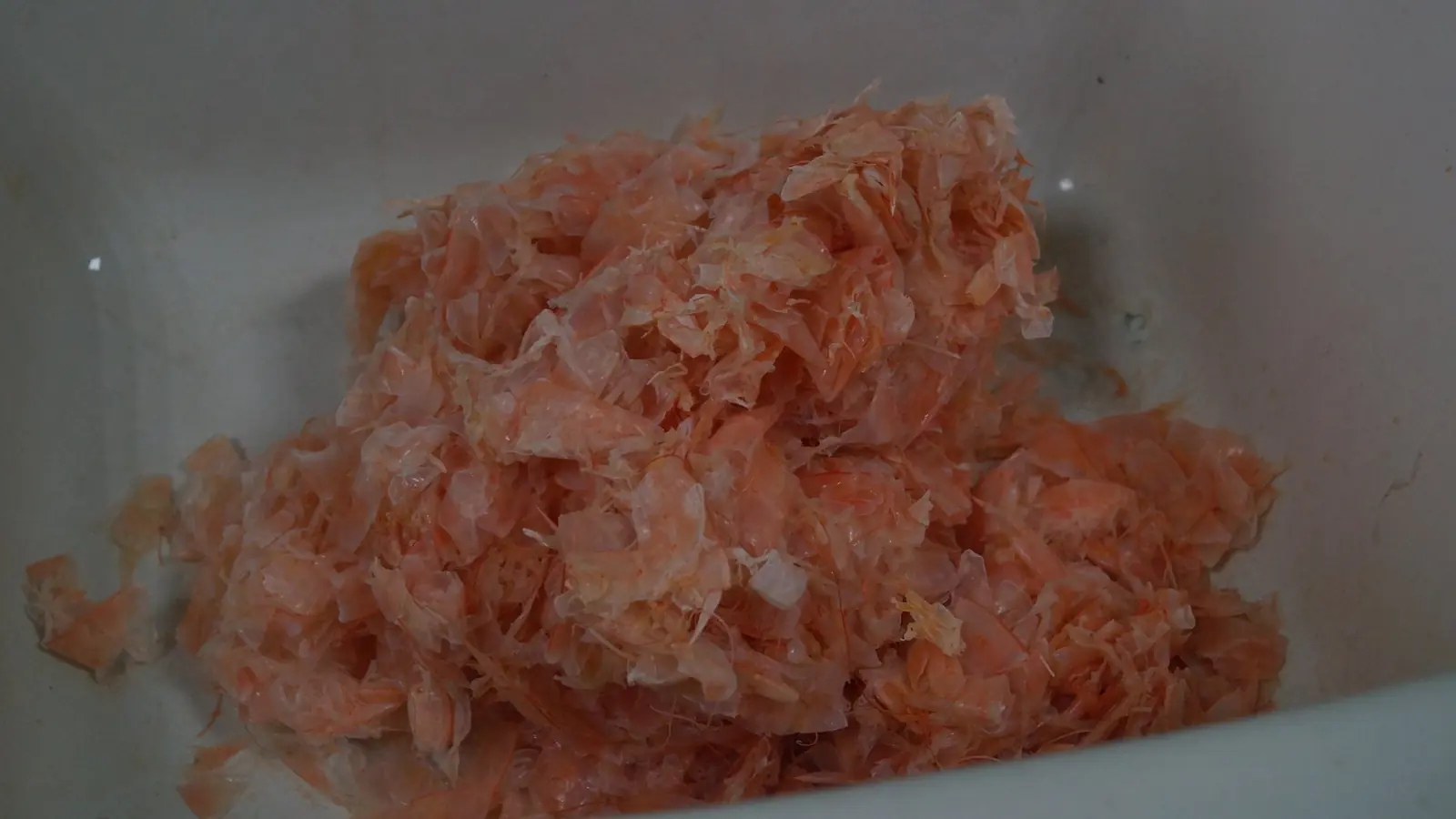
Commercially, chitosan is made from chitin isolated from crustacean shells after the edible parts are removed [4]. Shrimp and crab shells from seafood processing are the main source [1].
The usual chemical route has three steps. The shells are demineralized with acid to remove calcium carbonate, deproteinized with an alkaline treatment to remove proteins, and then deacetylated with concentrated alkali to turn chitin into chitosan [5]. Producers adjust each step, and those choices influence the grade that comes out at the end.
How chitosan is used in agriculture
Chitosan has a long history in US crop production. The US Environmental Protection Agency first registered it as a pesticide active ingredient in 1986. The US EPA’s fact sheet describes its use as a plant growth enhancer and as a substance that boosts plants’ ability to defend themselves against certain fungal infections [4]. This is how the EPA describes the ingredient, not a claim about any specific product.
In the scientific literature, chitosan is studied in several roles [3][6]:
- As an elicitor. Research published in Molecules (2022) reports that chitosan can trigger plant defense responses, including the production of defense-related compounds and proteins [3]. The review describes this as the most widely studied effect.
- As a biostimulant. Researchers have looked at its effects on germination, growth and tolerance to stresses such as salinity.
- As a coating. Because chitosan forms films, it has been tested as a coating for seeds and as a material that slows the release of fertilizers.
- After harvest. Chitosan coatings have been studied for keeping fruits and vegetables in good condition during storage.
These are findings from published research, not claims about any specific product.
UMass Extension lists chitosan among the main ingredient categories found in commercial biostimulant products, alongside humic substances, seaweed extracts and beneficial microbes [7].
A note of caution. Reviews point out that results depend heavily on the chitosan’s source, degree of deacetylation, molecular weight, concentration and pH [3]. Effects reported in one crop, dose or study don’t automatically carry over to another. That’s why formulators test grades in their own products and growing conditions instead of relying on general claims.
The regulatory picture in the US
Regulation follows the product and its label claims, not just the ingredient.
- Plant regulator claims. EPA’s draft guidance on plant regulators and biostimulants explains which products and label claims EPA treats as plant regulators. Those products are regulated as pesticides under FIFRA [8].
- Minimum risk list. In November 2022 EPA added chitosan, and certain chitosan salts, to its list of active ingredients eligible for the minimum risk pesticide exemption. Products that meet all the exemption’s conditions do not need federal FIFRA registration [9]. The conditions are specific, and products for food-use sites can only include ingredients with the applicable tolerances or tolerance exemptions [10].
- States. State agencies also regulate pesticides and fertilizers, so check the rules in each state where you sell.
If you sell a finished product, you are responsible for its registration, labeling and claims. A raw-material supplier can give you documents, but it can’t register your product for you.
What to check when buying chitosan for formulation
- Specifications that fit your use. Ask for the degree of deacetylation, viscosity or molecular weight, particle size, moisture and ash, and compare them with what your formulation needs.
- A certificate of analysis (COA). Ask for a COA tied to the lot you will receive.
- Solubility in your system. Chitosan dissolves in dilute acid. Check how a grade behaves in your actual formulation.
- Consistency between lots. Ask how the supplier handles variation, and plan your own incoming testing.
- Allergen and handling information. Chitosan from crustacean shells comes from a major food-allergen source. Purification affects how much residual protein remains [2][3]. Ask what handling documentation is available, and think about how this origin should appear in your own labeling.
- Samples. Qualify the material in your lab and field trials before committing to volume.
The bottom line
Chitosan is a shell-derived biopolymer with a long record in US agriculture and a large body of research behind its use in plant health. It isn’t one uniform product, though. The grade you pick, and how you formulate and label it, decide whether it does the job in your product.
Sources
- Santos VP et al. “Seafood Waste as Attractive Source of Chitin and Chitosan Production and Their Applications.” Int J Mol Sci 2020;21(12):4290. https://pmc.ncbi.nlm.nih.gov/articles/PMC7349002/
- Younes I, Rinaudo M. “Chitin and Chitosan Preparation from Marine Sources. Structure, Properties and Applications.” Mar Drugs 2015;13(3):1133. https://pmc.ncbi.nlm.nih.gov/articles/PMC4377977/
- Stasińska-Jakubas M, Hawrylak-Nowak B. “Protective, Biostimulating, and Eliciting Effects of Chitosan and Its Derivatives on Crop Plants.” Molecules 2022;27(9):2801. https://pmc.ncbi.nlm.nih.gov/articles/PMC9101998/
- US EPA. “Chitosan; Poly-D-glucosamine (128930) Fact Sheet.” https://www3.epa.gov/pesticides/chem_search/reg_actions/registration/fs_PC-128930_01-Jun-03.pdf
- Hosney A, Ullah S, Barčauskaitė K. “A Review of the Chemical Extraction of Chitosan from Shrimp Wastes…” Mar Drugs 2022;20(11):675. https://pmc.ncbi.nlm.nih.gov/articles/PMC9693855/
- Sharif R et al. “The Multifunctional Role of Chitosan in Horticultural Crops; A Review.” Molecules 2018;23(4):872. https://pmc.ncbi.nlm.nih.gov/articles/PMC6017927/
- UMass Extension, Greenhouse & Floriculture. “What are Biostimulants?” https://www.umass.edu/agriculture-food-environment/greenhouse-floriculture/fact-sheets/what-are-biostimulants
- US EPA. “Draft Guidance for Plant Regulators and Claims, Including Plant Biostimulants.” https://www.epa.gov/pesticides/draft-guidance-plant-regulators-and-claims-including-plant-biostimulants
- US EPA. “EPA Adds Chitosan to the List of Active Ingredients Eligible for Minimum Risk Pesticide Exemption” (Nov 8, 2022). https://www.epa.gov/pesticides/epa-adds-chitosan-list-active-ingredients-eligible-minimum-risk-pesticide-exemption
- US EPA. “Active Ingredients Allowed in Minimum Risk Pesticide Products.” https://www.epa.gov/minimum-risk-pesticides/active-ingredients-allowed-minimum-risk-pesticide-products